
TIL
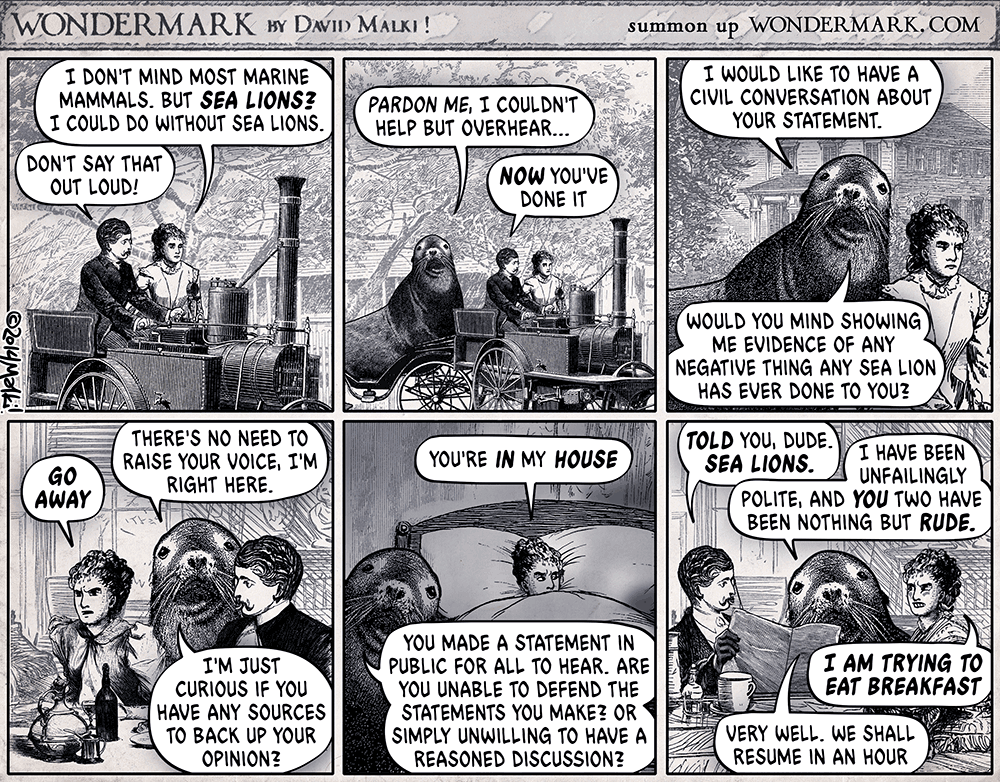
Sealioning (also sea-lioning and sea lioning) is a type of trolling or harassment that consists of pursuing people with relentless requests for evidence, often tangential or previously addressed, while maintaining a pretense of civility and sincerity (“I’m just trying to have a debate”), and feigning ignorance of the subject matter. It may take the form of “incessant, bad-faith invitations to engage in debate”, and has been likened to a denial-of-service attack targeted at human beings. The term originated with a 2014 strip of the webcomic Wondermark by David Malki, which The Independent called “the most apt description of Twitter you’ll ever see”.
It’s actually a strategy of spreading bullshit and then somehow blaming the person who asks you to back it up.
Yeah I’m kind of mixed on this concept, because there is nothing wrong with asking for a source and/or asking someone to explain their position. And it seems like a really bad idea to discourage people from asking questions like that.
I understand where you’re coming from, but it’ll be easy to tell. Someone who’s sealioning will skip or “forget” points you’ve already made when they’re making their counter arguments. The conversation will be irritating and demanding.
Someone who genuinely wants to discuss and learn won’t wear on you that way. Their replies won’t have that “I outsmarted you and you’re an idiot” kind of feel. It’s hard to explain, but people can recognize the difference. I don’t think there’s a threat to honest debate here.
Yes, it’s possible to confuse sealions with people who are simply rude and obnoxious, but since I don’t like talking to either one, I don’t much care.
The problem is not that it’s hard to to tell who is or is not sealioning. The problem is people using “sealioning” to go on the offensive against those who ask them to provide evidence or citations for their statements.
Fortunately, common sense usually works there, too. If person A makes highly specific or unusual statement, person B reasonably asks for a source, and person A angrily responds with defensiveness and accusations, then it’s pretty clear that person A was talking out of their ass.
I think the key part is whether it’s being done in good faith or bad faith. Sometimes I ask a stupid question on Lemmy, but because I am honestly curious and not trying to get into a fight, and I usually accept the reply to me and don’t take it as an invite to get into a debate, I think people can tell I’m not sealioning.
If I replied “source?” for your comment right now, I’d be trolling. I almost certainly know that it is a bad idea to discourage sourcing information, and that should not be something I need a cited source for. That would probably be sealioning. Someone asking for a source on a meme I posted is probably genuinely curious and not sealioning.
And as per usual, judging intent can be difficult, especially when people (including me) come into a forum with my own sets of biases, pieces of knowledge I have that I incorrectly assume that everyone else knows, and absence of knowledge that others incorrectly assume everyone else knows. So people who are not sealioning might get mistaken for it just because they want a source on something they do not know that most people do. I see where you are coming from.
Yeah. I strongly dislike this whole classification that politely asking someone to back up what they said, or asking basic questions about it, is proof that you’re a terrible person and grounds for immediately quitting the conversation.
It also strikes me as relevant that the same people who say it is a sin, also tend to have no problem with overtly toxic behavior like slinging extreme abuse at anyone who disagrees with them or otherwise being an asshole.
I mean there are some keywords and phrases in the actual textbook definition here like “trolling”, “harrassment”, “incessant bad-faith invitations”. It’s a legitimate thing, but I almost always see it being used illegitimately by someone to attack another who is simply asking them to back up their statements. For example:
A: statement
B: What is your source for this statement?
A: sToP sEaLiOnIng!!!
Yeah. There are genuine types of sophisticated trolling which involve pretending to be overtly polite while refusing to engage in any respect with the substance of what the other person’s saying, using politeness as a shield to sneak bullshit and bad-faith engagement into the discourse while making the other person look unreasonable if they start getting irritated about it.
In about 100% of cases where I’ve seen someone accused of “sealioning,” though, it is just that they are trying to engage with the conversation and ask for sources, if you have a certain way of approaching disagreement, that’s kryptonite to your argument and so the only response is to start whining about sealioning.
I have definitely come across what your first paragraph describes. Both sealioning and concern trolling definitely happens, on this site and on others.
Nice idea, but not sure I’ll follow. Nowadays I just try to ignore sealions and move on.